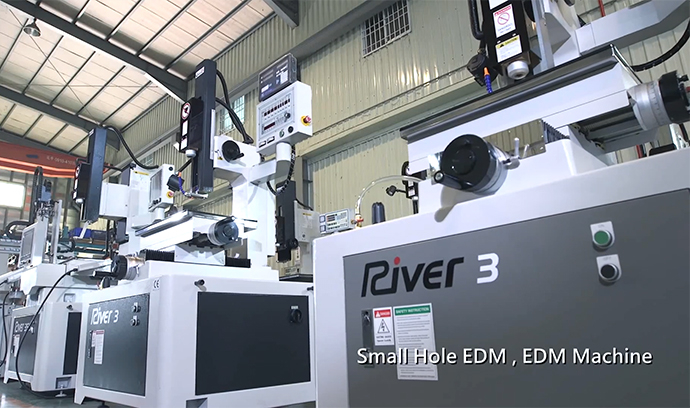
EDM Drilling (Small Hole EDM) is a specialized type of Electrical Discharge Machining (EDM). Its operating principle is based on applying a pulsed electrical voltage between a conductive metal electrode and the workpiece, which generates dense, high-temperature electrical sparks in the gap between them.
These electrical discharges locally melt and vaporize the workpiece material. The eroded metal particles are then flushed away from the machining area by the dielectric fluid, gradually forming the required micro-sized holes.
Unlike conventional mechanical drilling, the EDM drilling process involves no direct mechanical contact between the tool and the workpiece. This makes it particularly suitable for high-hardness, ultra-hard, or difficult-to-machine materials, such as nickel-based superalloys, carbide, and stainless steel, while maintaining high machining accuracy.
In addition, EDM drilling is capable of producing extremely small diameters (even below 0.1 mm), high aspect ratio holes, and shaped or special-profile holes. It is therefore widely used in aerospace, automotive, medical, and other high-end industries.
The main components of an EDM drilling machine include a high-frequency pulsed power supply, an automatic electrode feeding system, a dielectric fluid circulation system, and a CNC servo-controlled platform. By precisely controlling the pulse parameters and electrode feed, the process achieves high efficiency, high precision, and excellent repeatability in micro-hole machining.